Retool Kit
コースについて
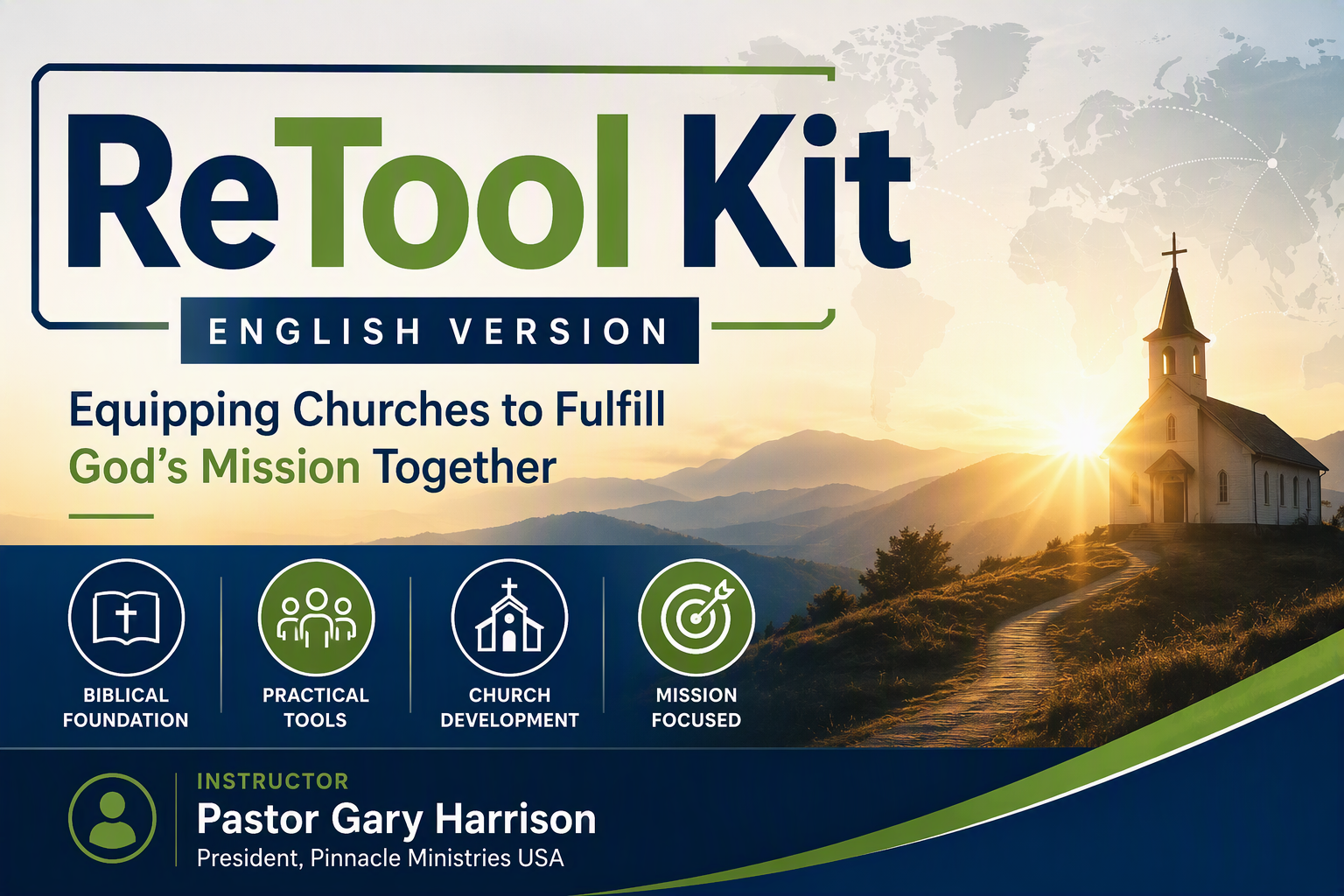
This is the English version of the ReTool Kit. The ReTool Kit is designed to help pastors and church members learn together the foundational process of church development and disciple-making. The course is taught by Pastor Gary Harrison, President of Pinnacle Ministries USA.
このコースで学べること
- • Clarify the church’s mission, vision, and disciple-making priorities.
- • Align church structures, ministries, and resources with biblical purpose.
- • Build a clear pathway from first contact to mature, reproducing discipleship.
- • Cultivate Christlike values, healthy relationships, and leadership character.
- • Recognize conflict patterns and practice redemptive, biblical communication.
- • Assess a church’s life-cycle stage and readiness for change.
- • Develop missional urgency through prayer, witness, community awareness, and practical action.
- • Identify realistic next steps for congregational renewal and local outreach.
コース内容
Retool Course 0 — Course Introduction
Retool Kit introduces a flexible process that helps churches respond faithfully to rapid cultural change. Rather than prescribing a single program, it provides tools for examining the church, its community, and personal ministry with fresh eyes. The central aim is to build shared vision and effective strategies that influence communities and the wider world through healthy disciples, leaders, and congregations. Participants move from understanding the church’s identity and heart to clarifying vision, shaping strategy, and implementing practical action. The course emphasizes discerning what Christ wants for his church, thinking beyond familiar assumptions, and choosing a realistic next faithful step together.
-
Lesson 0 Renewing the Church for Faithful Mission in a Changing Culture
00:00
Retool Course 1 The Heart and Pathway of the Church
Lesson 1 presents the church as three interlocking realities: cause, community, and corporation. Its cause is the mission of making obedient disciples among familiar and unfamiliar peoples; its community is a healthy body shaped by teaching, fellowship, worship, prayer, generosity, and loving relationships; and its corporation is the structure that turns vision into coordinated action. Ministries, finances, leadership systems, and traditions should therefore be evaluated by their alignment with mission rather than preserved automatically. The lesson also traces Jesus’ reproducible pathway from “come and see,” to “follow me,” to serving, leading, and reproducing. Churches must offer clear next steps for seekers, believers, disciples, and emerging leaders, while trusting the Spirit to bring transformation.
-
Lesson 1-1 Mission and Vision: Making Obedient Disciples
00:00 -
Lesson 1-2 Structuring the Church to Fulfill Its Mission
00:00 -
Lesson 1-3 Building a Healthy and Participatory Church Community
00:00 -
Lesson 1-4 Jesus’ Reproducible Pathway of Discipleship
00:00 -
Lesson 1-5 Evaluating the Church and Choosing the Next Faithful Step
00:00
Retool Course 2 Values for Transforming and Reproducing Leaders
Lesson 02 explains that leadership formation begins beneath skills and behavior, at the level of beliefs and values. Every culture must be tested and reshaped by God’s Kingdom, with John 15 highlighting three core values: lifelong transformation, loving interdependence, and spiritual reproduction. Transformation requires renewed thinking, personal responsibility, Scripture, prayer, service, rest, and other disciplines adapted to real life. Interdependence means growing through truthful, safe relationships in which every member gives and receives ministry and discovers gifts through service. Reproduction extends faith through witness, family, friendship, community care, mentoring, and disciples who equip others. A candid values health check helps individuals and churches identify hidden struggles, weak practices, and concrete next steps toward Christlike maturity.
-
Lesson 2-1 Kingdom Values for Transformational Leadership
00:00 -
Lesson 2-2 Practicing Lifelong Spiritual Transformation
00:00 -
Lesson 2-3 Growing through Loving Interdependence
00:00 -
Lesson 2-4 Reproducing Faith through Witness, Service, and Disciple-Making
00:00 -
Lesson 2-5 Assessing Values and Taking Intentional Steps toward Growth
00:00
Retool Course 4 Character, Community, and Redemptive Conflict
Lesson 04 treats character formation and conflict competence as essential leadership practices learned through trusted relationships and visible example. Leaders model Christian life by encouraging, correcting, submitting, confessing failure, and recovering faithfully. Healthy communities hold truth and grace together, recognize passive, evasive, defensive, and aggressive conflict styles, and intervene before disagreements escalate into contests, factions, or destructive battles. Matthew 18 offers a progressive path: begin with direct private conversation, involve wise witnesses when needed, and seek broader leadership help to pursue restoration. Shared training and a communication covenant can redirect gossip, reject anonymous criticism, protect confidentiality, and favor face-to-face conversation. Practiced consistently and prayerfully, these commitments turn conflict into growth and strengthen the church’s unity and witness.
-
Lesson 4-1 Forming Character through Modeling and Mentoring
00:00 -
Lesson 4-2 Balancing Truth and Grace in Conflict
00:00 -
Lesson 4-3 Recognizing and Interrupting Conflict Escalation
00:00 -
Lesson 4-4 Following a Redemptive Process for Conflict Resolution
00:00 -
Lesson 4-5 Establishing a Covenant for Healthy Communication
00:00
Retool Course 5 Missional Urgency and Readiness for Change
Lesson 05 distinguishes biblical urgency from institutional desperation and calls churches to act from mission rather than fear of decline. Acts 4 portrays a threatened church praying for boldness and for God to prepare the ground for witness. A church life-cycle model helps congregations identify movement from birth, growth, and maturity toward maintenance, decline, and death, while recognizing how outward focus, faith, innovation, and flexible structures can be recovered. Urgency grows through prayer, teachable moments, leadership example, intentional relationships, simple gospel skills, and concrete first steps. The lesson concludes with practical tools for cultivating and blessing relationships, celebrating witness, evaluating readiness for change, and ensuring that vision, values, leadership, planning, decision-making, communication, and structure remain aligned with disciple-making.
-
Lesson 5-1 Choosing Biblical Urgency over Desperation
00:00 -
Lesson 5-2 Diagnosing the Church Life Cycle
00:00 -
Lesson 5-3 Cultivating Missional Urgency through Prayer and Practice
00:00 -
Lesson 5-4 Taking First Steps and Assessing Readiness for Change
00:00
生徒の評価とレビュー

評価がありません